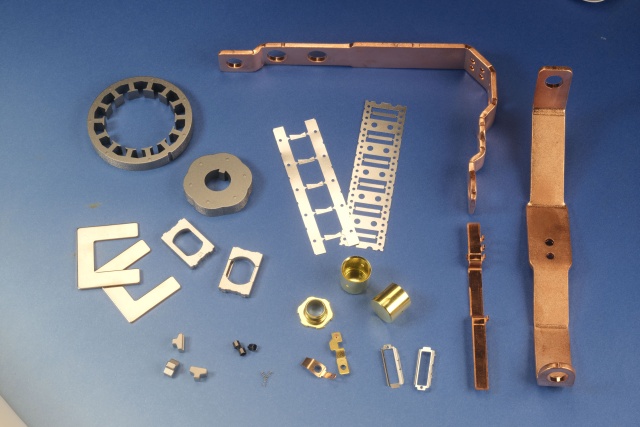
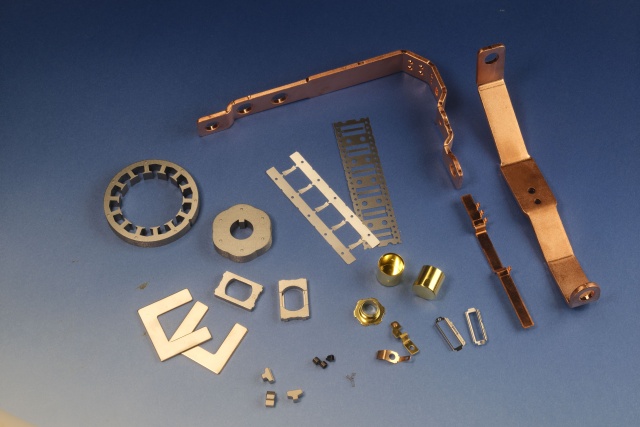
An assembly rarely runs on a single stamped part. This assortment brings together every formed and molded component that sits inside one motor, switch or sensor unit, so a project team can plan the whole set against one drawing package instead of coordinating several suppliers and matching parts from different tool rooms. Because custom metal stamping, molding and final inspection run across the group, the fit between parts is settled at design stage rather than discovered on the line. It suits OEMs and system integrators building electric motors, switch assemblies, sensor modules and compact electronic devices, and it works as well for a new program as for consolidating an existing bill of materials.
Finish is chosen part by part, because one set can ask for very different surfaces. Brass shells and switch contacts are plated so the conductive surface resists corrosion and keeps contact resistance stable over the life of the assembly. Stator and rotor laminations take a surface insulation treatment that limits losses between stacked sheets, while brackets and clips are usually coated for rust prevention and a clean appearance inside the housing. Because finishing runs alongside our stamping and injection molding services, parts move from forming to plating or coating without a handover between vendors. Confirm your salt-spray or appearance standard, the coating thickness and any masking requirements before the first batch goes through finishing.
Woosung is a precision component manufacturer serving OEMs and system integrators across automotive, electric motor, industrial equipment, and electronics programs. Our range covers aluminum plate assemblies, stator and rotor laminations, iron cores, copper shells, brass contacts, and custom-shaped brackets and clips, produced through metal stamping, injection molding, and stamping-and-stacking. Custom tooling, material selection, surface treatment, and structure design follow your drawings and specifications, and our global facilities support scalable batch production with unified quality standards and dependable turnaround.
You can take the full set or order only the groups your build still needs. Every part is produced against the same drawings and the same inspection plan, whether it comes off our stamping lines or through our injection molding services, so a partial order never means a different standard.
Usually when one component has to conduct or carry load and also hold a shape that is slow or costly to form in metal. The stamped insert provides the conductivity and strength, while custom injection molding forms the housing, the insulation and the mounting features around it. The result is one part instead of several, which means fewer interfaces to tolerance in the finished assembly.
Yes. Stator and rotor laminations are built to your profile, slot pattern and stack height, and custom-shaped iron cores can follow a non-standard outline. Precision metal stamping keeps the lamination edges consistent through the stack, which is what holds magnetic performance steady from one batch to the next. Confirm the stack height and the profile dimensions that matter before tooling starts.
Send the grade on your drawing and we build to it. Brass, electrical and silicon steel, aluminum and stainless steel can all go through custom metal stamping, and molded portions are produced from the plastic the application calls for. If a tolerance on the drawing is tighter than the part really needs, tell us which dimensions are functional and we will keep the rest at a practical level.
Usually yes. Structural parts sit at the edge of the assembly, so a revised mounting tab normally means a change to that one tool. As a stamping parts manufacturer we keep structural tooling separate from the lamination and contact tools, so the magnetic and electrical parts stay untouched unless the interface they share with them also moves.
Keep them in the original moisture-proof packaging until they reach the line. Plated surfaces should not be handled with bare hands or left where condensation can settle on them, and laminations should be stored flat and out of damp air so the stack stays true and the edges do not corrode.