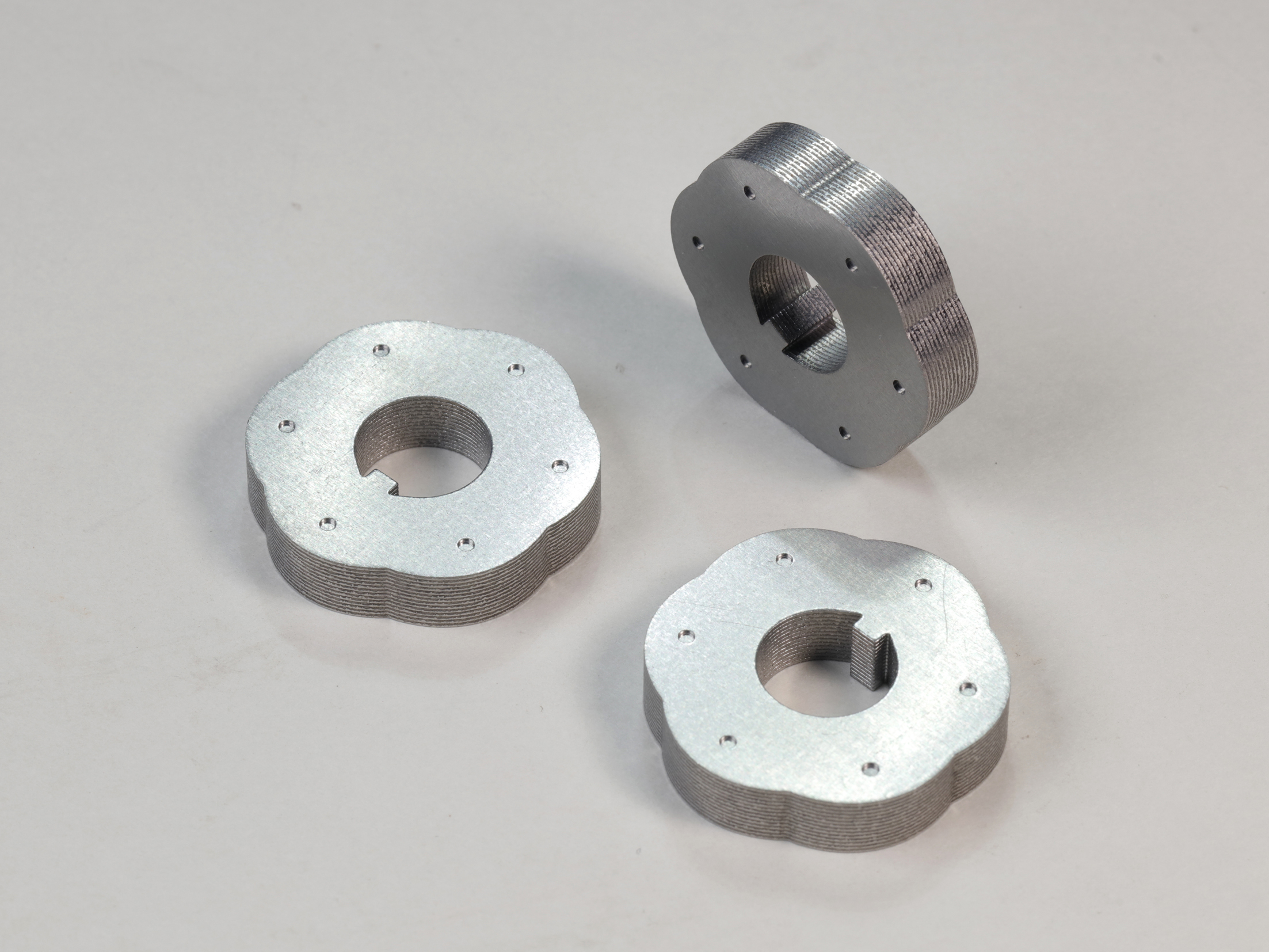
The Automotive Iron Core - Rotor is the rotating magnetic core of an electric motor: a stack of individually stamped silicon steel laminations, produced on automotive metal stamping tooling, pressed into one solid annular body with a central bore for shaft mounting. Automotive OEMs and motor manufacturers fit it into EV and HEV traction motors, auxiliary motors and industrial drives where the core has to hold a stable magnetic field through thousands of start-stop cycles. In service it sits opposite a stator core of the same frame size, so the two halves of the magnetic circuit are usually designed and produced as a pair. When a rotor core is replaced in an existing platform, we work to the mounting features and lamination profile already in use rather than redesigning around them.
| Material | High-grade silicon steel |
| Construction | Individually stamped laminations stacked into one core |
| Process | Precision metal stamping and stamping-and-stacking |
| Lamination surface | Insulation treatment across the stack |
| Core position | Rotor (rotating member of the motor) |
| Magnetic behaviour | Low iron loss, stable flux pathways |
| Mechanical behaviour | Vibration resistance for repeated start-stop duty |
| Motor types | EV and HEV traction motors, auxiliary motors, industrial motors |
| Tolerance approach | Tight stacking and lamination thickness control |
| Customization | Core geometry sized to your motor drawing |
High-grade silicon steel is the starting point because it carries a strong magnetic flux while keeping hysteresis and eddy-current losses low. The laminations are cut on custom metal stamping dies and then stacked under controlled pressure, so the finished core holds its profile instead of relaxing out of tolerance in service. Cutting the core into thin laminations rather than machining it from solid stock is what limits circulating currents inside the material, and it also lets us tune stack height to the motor's operating point. The same tooling carries a design from a first development build into volume production, so magnetic behaviour does not shift when quantities go up.
A rotor core only performs as well as its fit inside the motor, so each core is built to the mounting features, stack height and air gap already defined in your design. It is made to sit opposite a matching stator core of the same frame size, and both halves can come off one line so the lamination grade and insulation treatment stay consistent across the magnetic circuit. Where a motor needs extra insulation or structural support, we add it through custom injection molding without disturbing the lamination stack or its magnetic behaviour. Because the cores follow existing motor platform dimensions, they slot into established assembly workflows — send us the drawing or a sample core and we will confirm the interfaces before tooling starts.
Woosung is a precision component manufacturer serving OEMs and system integrators across automotive, electric motor, industrial equipment, and electronics programs. Our range covers aluminum plate assemblies, stator and rotor laminations, iron cores, copper shells, brass contacts, and custom-shaped brackets and clips, produced through metal stamping, injection molding, and stamping-and-stacking. Custom tooling, material selection, surface treatment, and structure design follow your drawings and specifications, and our global facilities support scalable batch production with unified quality standards and dependable turnaround.