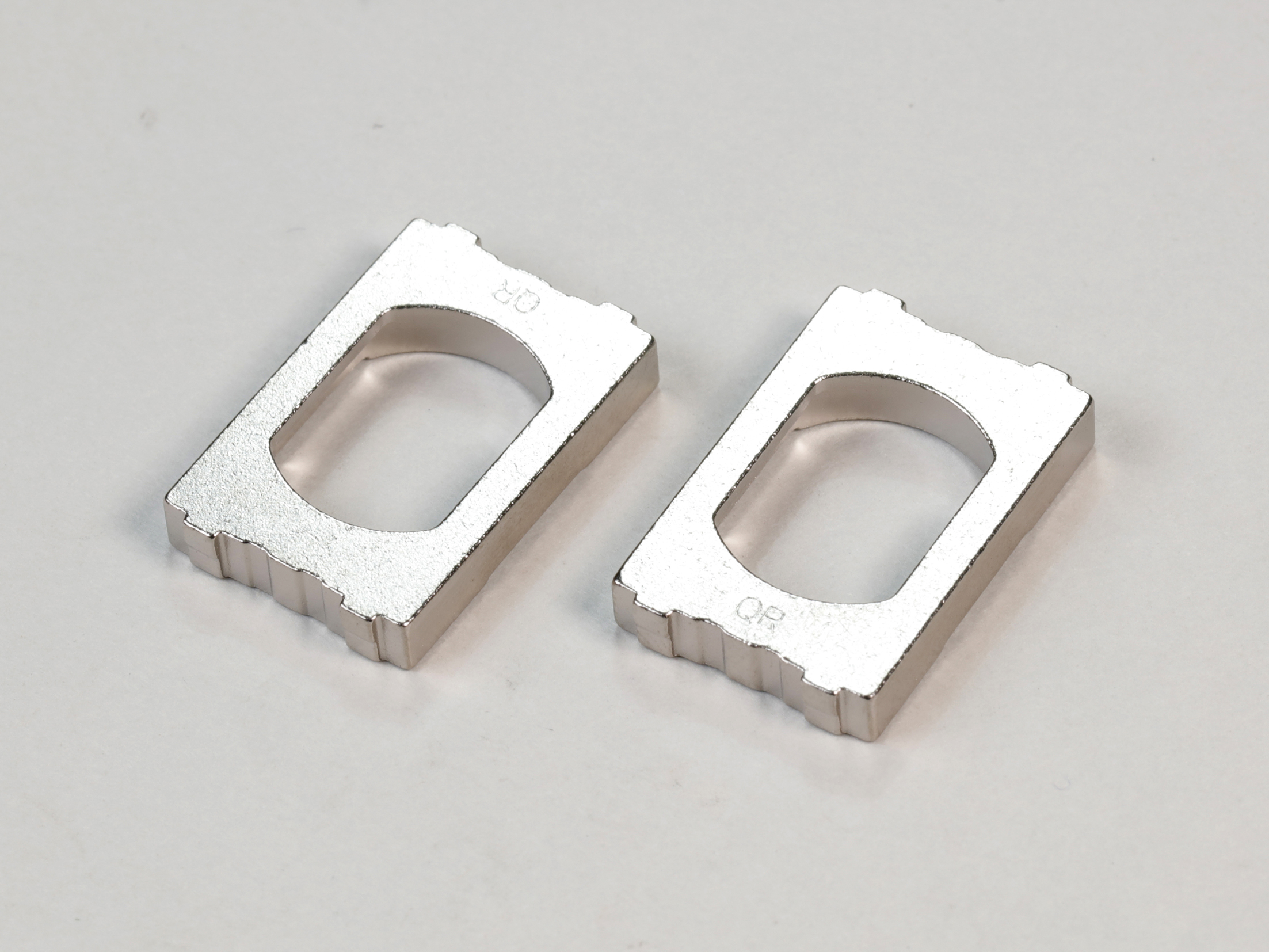
A custom-shaped component is a formed metal part built around the geometry an assembly actually needs, rather than the nearest standard bracket. We make them by custom metal stamping, so open cutouts, offset bends, mounting ears and notched edges all come out of the same forming sequence — one part where a stack of separate brackets and fasteners used to sit. The buyers we work with are mostly automotive Tier suppliers, industrial equipment builders and electronics manufacturers, all of whom need a part shaped around their own assembly rather than a catalogue item. Because the shape lives in the tooling instead of being repeated by hand, the part comes out the same way run after run, which is what matters when the same bracket goes onto thousands of units. Tell us the application and we will say whether the geometry forms cleanly and which material suits it.
| Component type | Custom-shaped stamped metal component |
| Forming process | Precision metal stamping |
| Material options | Copper, iron, stainless steel, aluminum |
| Design input | 2D/3D drawings, or a physical sample |
| Feasibility review | Forming limits checked against your drawing before the tool is cut |
| Surface treatment | Spraying, electroplating, polishing, galvanizing |
| Edge finish | As-cut, deburred or polished, matched to fit and handling |
| Secondary processes | Precision blanking, cold forging, deep drawing, bending, laser cutting |
| Identification | Part number or QR marking stamped on the surface where traceability is needed |
| Assembly role | Holding, mounting and fixturing inside a larger assembly |
| Packaging | Anti-static and moisture-proof, with dust-free packing for precision parts |
| Production format | Repeat batch runs from approved tooling |
Woosung is a precision component manufacturer serving OEMs and system integrators across automotive, electric motor, industrial equipment, and electronics programs. Our range covers aluminum plate assemblies, stator and rotor laminations, iron cores, copper shells, brass contacts, and custom-shaped brackets and clips, produced through metal stamping, injection molding, and stamping-and-stacking. Custom tooling, material selection, surface treatment, and structure design follow your drawings and specifications, and our global facilities support scalable batch production with unified quality standards and dependable turnaround.
Open cutouts, notched edges, offset bends, asymmetrical outlines, mounting ears and clearance reliefs are routine for custom stamping parts. The practical limit is usually the material and thickness rather than the outline, since deep draws and very sharp internal corners take more tooling work. Send us the geometry you have and we will say whether it forms cleanly as a single part or benefits from a small design change.
Mostly it comes down to fit. A formed part stays in place when the interface between it and its mating feature is built to the drawing rather than to a general range, because there is no play for vibration to work against. Material grade and thickness reinforce that, since lighter stock flexes more under load. Tell us how the part is mounted and what it sits against, and we will match the material and thickness to the custom sheet metal stamping geometry you need.
Yes. The part shown here carries a stamped QR mark on its face, and the same process can form a part number, a QR code or a simple orientation mark. Tell us what the mark has to say and where it must sit on the custom sheet metal stamping part, and we will confirm that it fits the geometry before tooling is cut.
It will, because the same approved tooling, material source and inspection routine are used each time. As a metal stamping manufacturer working from our own tooling, we can also tell you up front whether a design change would need a tool modification rather than a simple setup adjustment.
Small enough to sit inside a compact device housing and still do a structural job. What limits the size is the features rather than the outline: a small part with generous tolerances forms easily, while several tight features on a small outline need more careful tooling and a longer look at the design. Send us the space it has to work within and we will say what is realistic.
Usually, yes. Tooling is built for the geometry, and moving to another metal is often a matter of adjusting the forming setup and confirming that the new grade bends without cracking. Springback and minimum bend radii differ between grades, so it is worth telling us at the start that a second material is likely, and we can design the tool with that change in mind.