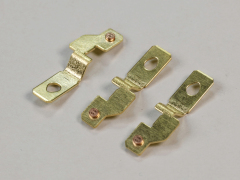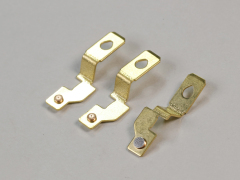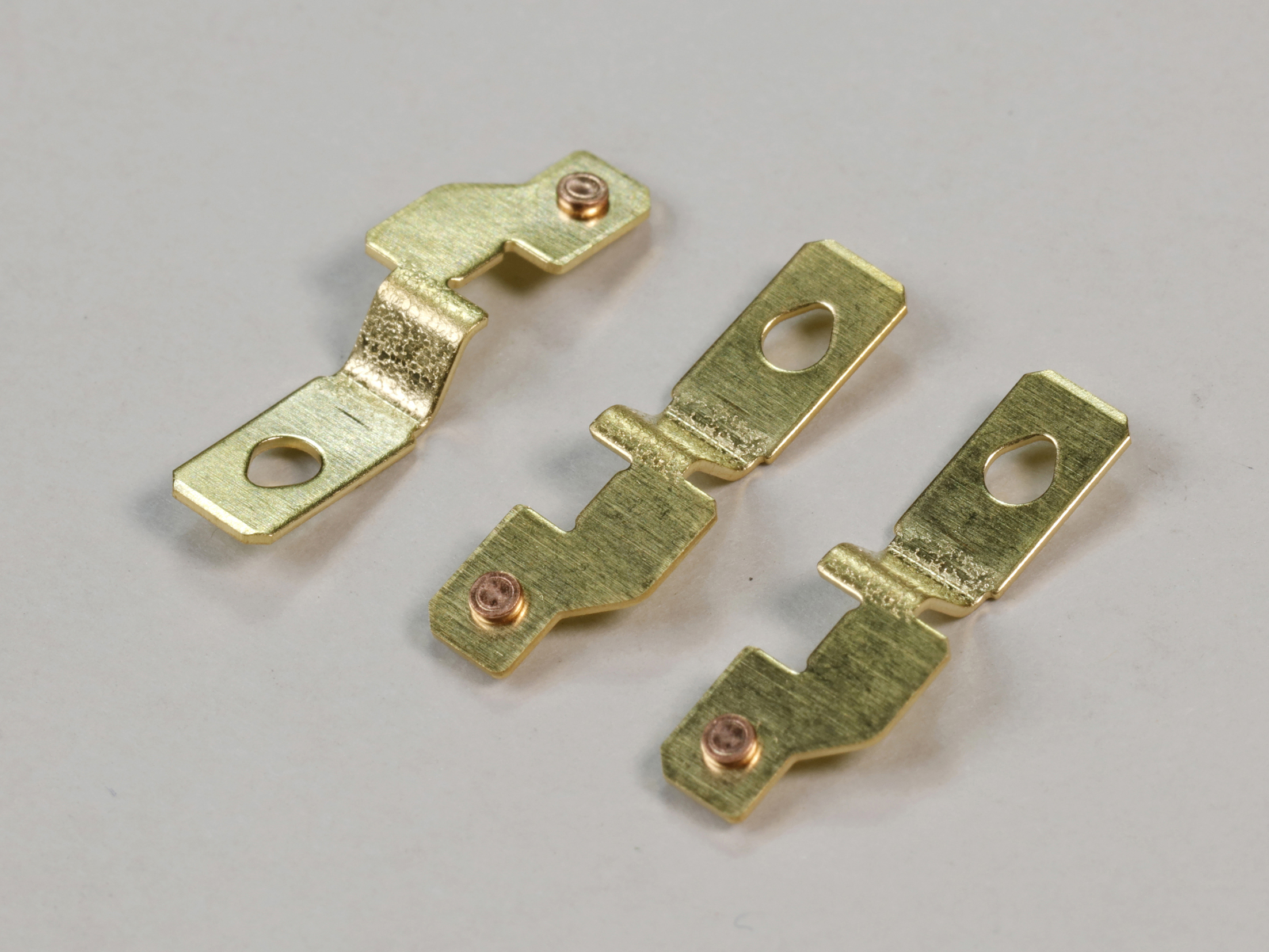
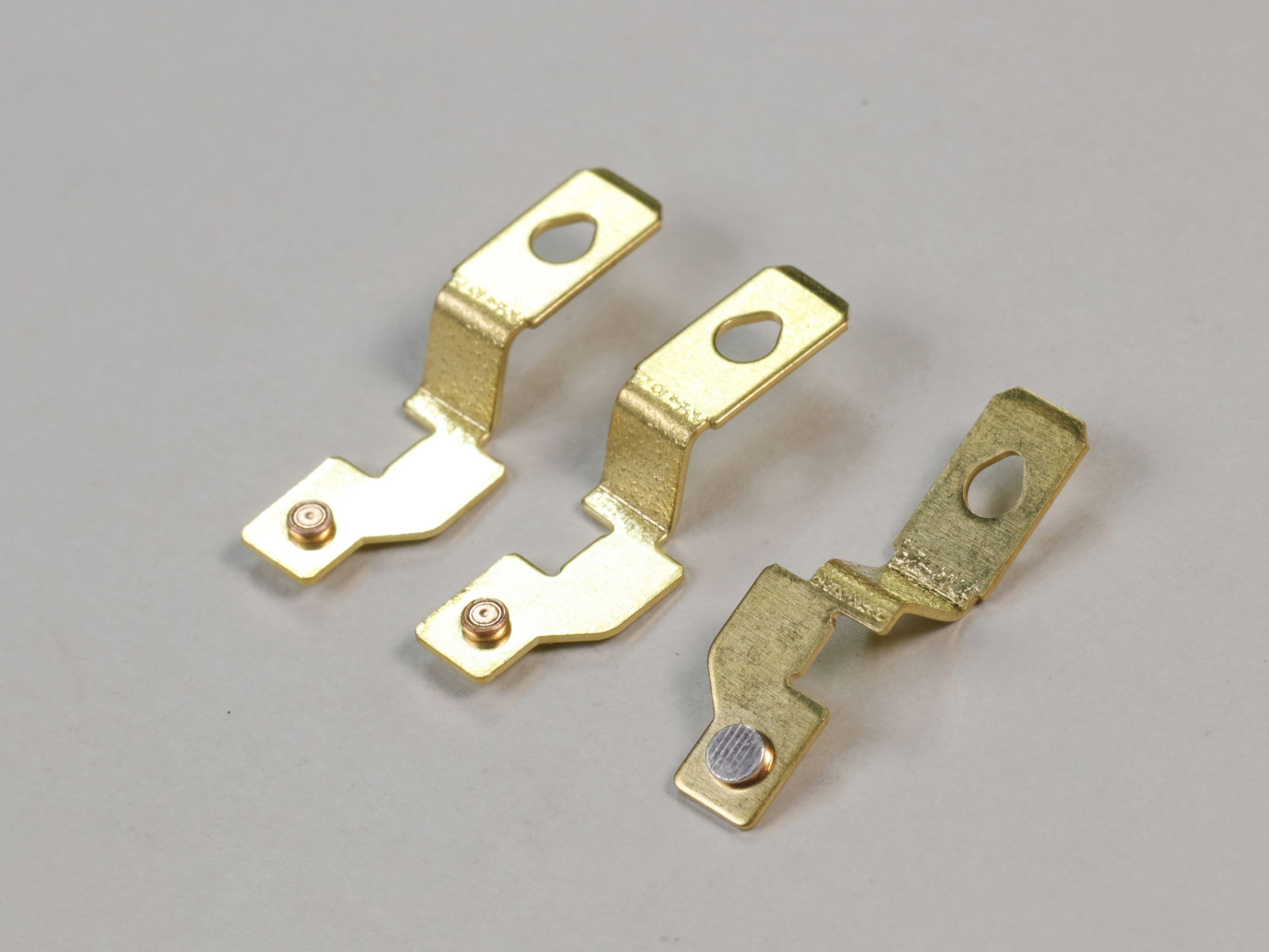
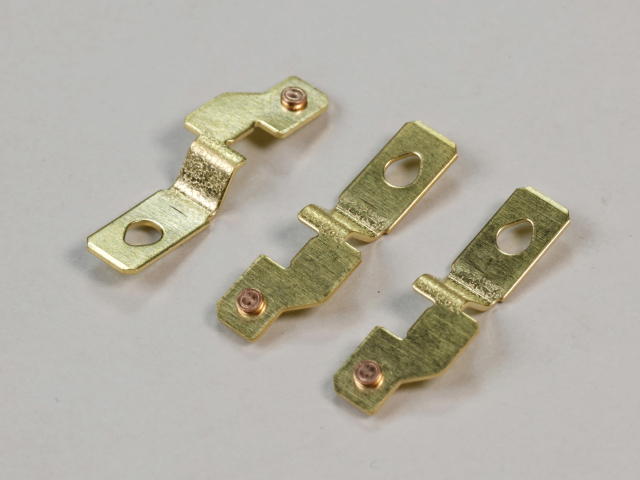
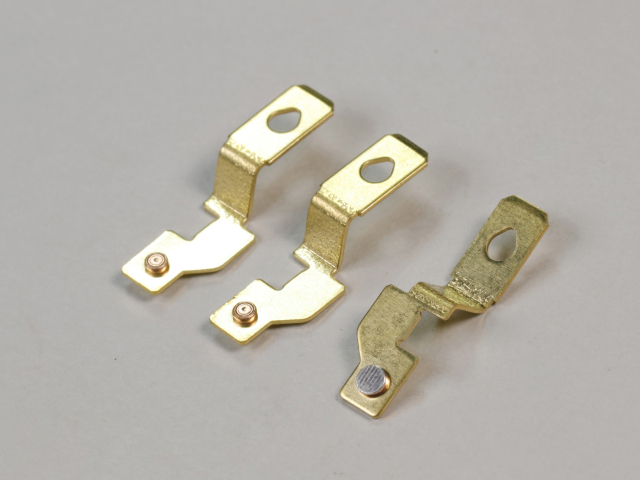
| Product Model | 52170000160 | Picture |
|---|---|---|
| Production Process | Continuous stamping, silver plating | 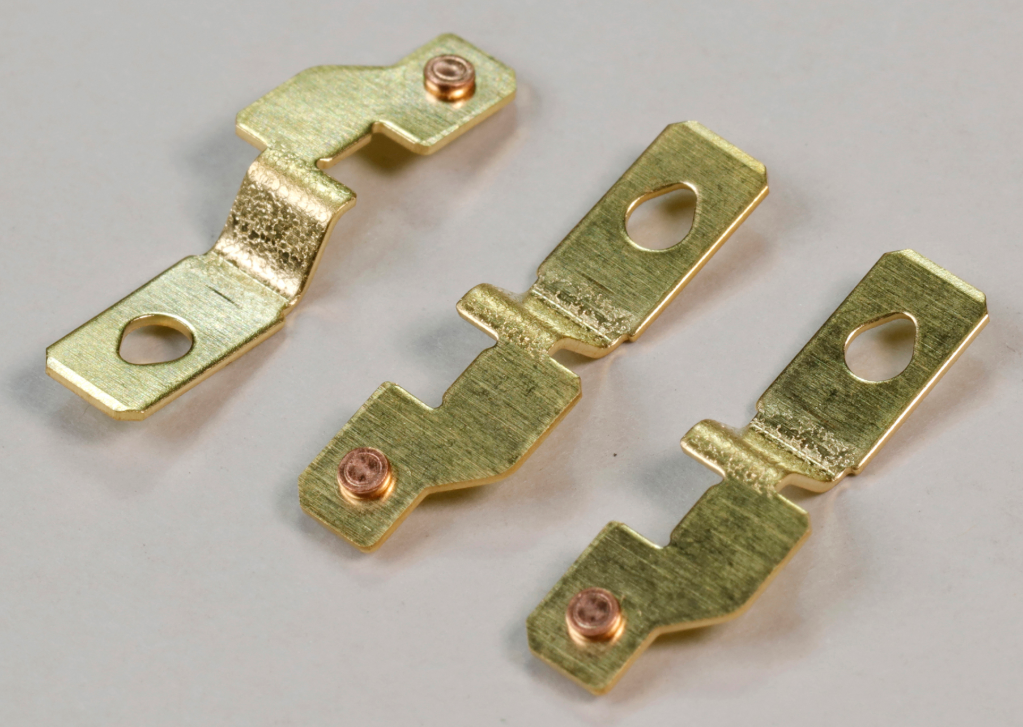 |
| Product Specifications | 2.51.50.3 | |
| Product Material | Brass H65 | |
| Application areas | For small motor switches in laptops | |
| Notes | No special notes |
Good electrical conductivity of H65 brass base material, silver plating treatment reduces contact resistance and enhances wear resistance; 2.51.50.3 miniature size, suitable for precision contact requirements of small motor switches.
| Product type | Miniature stamped switch contact |
| Model | 52170000160 |
| Surface treatment | Silver plating |
| Production process | Continuous precision metal stamping |
| Nominal profile | 2.5 × 1.5 × 0.3 mm |
| Contact performance | Low and stable resistance under repeated switching |
| Corrosion resistance | Plated surface resists oxidation |
| Design flexibility | Customizable to suit different switch types |
The main job for this contact is the small motor switch inside a laptop computer, where the switch has to open and close reliably in a very shallow space. It also suits other compact switch assemblies that need a low-resistance plated face on a small contact footprint. Design teams call on it when a switch is being re-specified and the previous contact was either too big for the cavity or came from a supplier whose parts changed between batches. It is equally useful where a hand-formed or cut-to-length contact has been causing inconsistent assembly, because a stamped and plated part seats the same way every time. If your switch cavity is tight, send the drawing and we will confirm whether the standard form seats correctly or whether an adjusted form is needed.
Woosung is a precision component manufacturer serving OEMs and system integrators across automotive, electric motor, industrial equipment, and electronics programs. Our range covers aluminum plate assemblies, stator and rotor laminations, iron cores, copper shells, brass contacts, and custom-shaped brackets and clips, produced through metal stamping, injection molding, and stamping-and-stacking. Custom tooling, material selection, surface treatment, and structure design follow your drawings and specifications, and our global facilities support scalable batch production with unified quality standards and dependable turnaround.
The standard form is built for the small motor switches used in laptop computers, and it suits other compact switch assemblies where the contact area is small and the mating terminal needs a clean, low-resistance face. Because the design can be adapted, other switch types can be matched as well. Send the housing drawing and we will confirm whether the existing form fits or an adjusted one is required.
Bare brass conducts well, but its surface oxidises over time and that raises resistance exactly where the terminal touches. The silver layer keeps the interface clean and stable through repeated switching, and it wears more evenly than the raw brass underneath. The plating is applied after custom brass stamping, so the layer follows the finished contact shape.
The contact is stamped from Brass H65, a copper-zinc alloy we run regularly, so the strip behaviour, forming characteristics and plating response are already established in our process. If your specification calls for a different brass grade or a different base metal, tell us at the enquiry stage and we will confirm what we can supply for your switch design.
It is made in two main stages: continuous precision metal stamping forms the contact profile from brass strip, then the parts are silver plated as a finished profile. Continuous stamping means every part comes off the same tool, so the geometry that passed your sample is the geometry that arrives in production. Dimensional and appearance checks are carried out before packing.
Check that the contact seats fully in the switch cavity without stressing the housing, that the mating terminal meets the plated face squarely rather than on an edge, and that the locating feature lines up with your assembly fixture. If you can send a switch sample, we can check the fit against it before you commit to a production order.
Yes. The outer form, the locating feature and the position of the contact face can all be adjusted to suit a different switch type. Changing the form usually means new tooling, so share your switch drawing early and we will tell you whether a small adjustment is enough or a new tool is needed.